
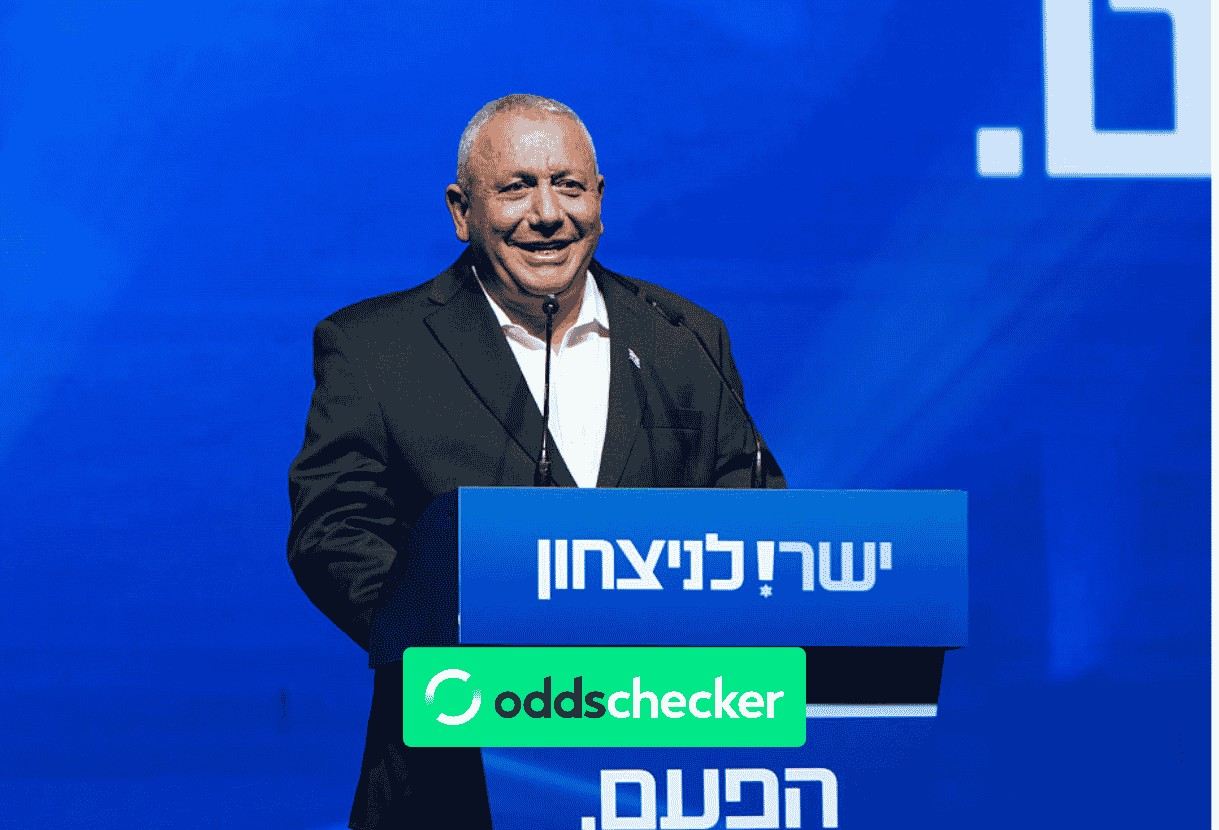
Gadi Eisenkot leads the Israeli election 2026 odds at 4/5, attracting 75% of Tuesday's bets. Latest Netanyahu odds, election date and results timetable.
Gadi Eisenkot is the odds-on favourite to become Israel's next Prime Minister, with 75% of bets placed through Oddschecker on Tuesday backing the former military chief.
Israelis are heading to the polls today (Tuesday 27 October) in a closely contested election that could bring an end to Benjamin Netanyahu's latest term in office.
The election is the country's first since the Hamas-led attacks of 7 October 2023 and the subsequent wars in Gaza, Lebanon and Iran.
Eisenkot is the 4/5 favourite to replace Netanyahu, who is priced at 11/8 to remain Prime Minister, while former leader Naftali Bennett is a 7/1 outsider.
With opinion polls suggesting neither of the two main political blocs is guaranteed a parliamentary majority, the outcome could depend on coalition negotiations after voting concludes.
Israeli Election 2026 Odds: Who Will Be the Next Prime Minister?
The latest betting odds make Gadi Eisenkot the favourite to become Israel's next Prime Minister.
| Candidate | Latest Odds | Implied Probability |
|---|---|---|
| Gadi Eisenkot | 4/5 | 55.6% |
| Benjamin Netanyahu | 11/8 | 42.1% |
| Naftali Bennett | 7/1 | 12.5% |
| Avigdor Lieberman | 33/1 | 2.9% |
| Yair Lapid | 50/1 | 2.0% |
Gadi Eisenkot Attracts 75% of Bets on Election Day
Gadi Eisenkot has emerged as the clear favourite among Oddschecker bettors, accounting for 75% of all bets placed on Tuesday in the next Israeli Prime Minister market.
The former chief of staff of the Israel Defense Forces leads the centrist Yashar party and is considered Netanyahu's strongest challenger.
Eisenkot has campaigned on restoring public trust, strengthening national security and establishing an independent inquiry into the failures surrounding the 7 October 2023 attacks.
His military background has become a central part of his appeal, particularly among voters questioning Netanyahu's handling of Israel's security challenges.
According to Reuters' latest polling analysis, Eisenkot's Yashar and Netanyahu's Likud were level in projected parliamentary seats ahead of election day.
However, while opposition parties collectively appeared capable of winning more seats than Netanyahu's allies, significant disagreements between them could complicate efforts to form a government.
Can Benjamin Netanyahu Remain Prime Minister?
Benjamin Netanyahu is the 11/8 second favourite to retain his position, despite facing one of the toughest electoral challenges of his political career.
Israel's longest-serving Prime Minister returned to power following the November 2022 election, when his coalition secured 64 of the 120 seats in the Knesset.
However, his leadership has faced sustained scrutiny following the October 2023 attacks, the subsequent conflicts across the Middle East and disagreements over military service exemptions for ultra-Orthodox Jewish men.
Netanyahu has defended his government's security record, arguing that his leadership has been essential in confronting Israel's regional adversaries.
The incumbent also received a public endorsement from US President Donald Trump in the final stages of the campaign.
Despite trailing Eisenkot in the betting, Netanyahu could still retain power if he secures sufficient support from other parties to assemble a governing coalition.
Former Prime Minister Naftali Bennett is third in the market at 7/1. Bennett is contesting the election alongside former Prime Minister Yair Lapid on the Together party list, with both seeking to provide an alternative to Netanyahu's leadership.
When are the Israeli Elections?
The 2026 Israeli general election takes place on Tuesday 27 October 2026, with voters electing representatives to the country's 120-seat parliament, the Knesset.
Polling stations opened at 7am local time (5am GMT) and are scheduled to close at 10pm local time (8pm GMT).
Unlike a presidential election, Israeli voters do not directly elect their Prime Minister. Instead, they vote for political parties, which receive parliamentary seats through proportional representation.
A governing coalition normally requires the support of at least 61 of the Knesset's 120 members.
With neither major political bloc assured of that majority, negotiations between parties could ultimately determine whether Eisenkot replaces Netanyahu.
When will the results of the Israeli Elections be announced?
The first indications of the 2026 Israeli election results are expected at 10pm Israeli time (8pm UK time) on Tuesday 27 October, when polling stations close and television broadcasters publish their exit polls.
However, the official results will not be available immediately.
According to Reuters, the expected results timetable is:
Tuesday 27 October: Polls close at 8pm UK time, with exit polls published shortly afterwards.
Wednesday 28 October: Vote counting continues, with preliminary results providing a clearer indication of the outcome.
Friday 30 October: The final vote tally is expected.
Wednesday 4 November: Official election results are scheduled to be published.
Even after the final results are confirmed, the identity of Israel's next Prime Minister may remain uncertain.
President Isaac Herzog will consult political party leaders before asking the candidate considered most likely to command a parliamentary majority to form a government.
That candidate can be given up to 42 days to negotiate a coalition.
With polling pointing towards a closely divided Knesset, Israel could face several weeks of political negotiations before its next government is confirmed.