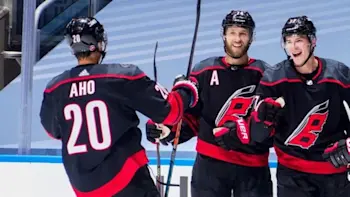
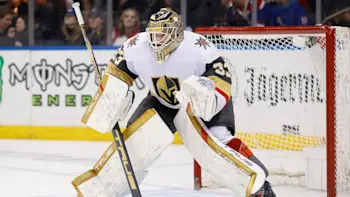
NHL Games
Tuesday, September 29
Sep 29
Tuesday, September 29
Sep 29
The real-time lines you see above display up-to-the-minute puck lines, moneylines, and totals compiled straight from every major legal US sportsbook.
By comparing these markets side by side, Oddschecker automatically highlights the best available price for every single selection, ensuring you never leave money on the table.
Instead of logging into multiple betting apps to hunt down value, you can spot the highest payout for your exact wager instantly right here.
NHL odds represent the statistical probability of a game outcome occurring, translated into financial terms to show how much risk is required to secure a specific profit. If you are looking at an NHL betting board for the first time, the numbers tell you which team is expected to win, which is expected to lose, and exactly how much the sportsbook will charge you to handle the transaction.
Every matchup features a favorite (the team projected to win, indicated by a minus sign like -150) and an underdog (the team projected to lose, indicated by a plus sign like +130).
Even when sportsbooks split a game using a point margin or balanced line, you will notice that both sides are typically priced with an extra fee attached rather than a flat even-money (+100) return. This built-in price difference is known as the "vig" or "juice" - essentially the house fee for balancing the action.
A Quick Example: A standard -110 figure means you must risk $110 in real money to win $100 in pure profit.
Let’s look at a classic divisional matchup to see how these numbers operate across different betting styles. Imagine a game where the Boston Bruins are listed at -1.5 (+135) on the puck line and -180 on the moneyline, while the New York Rangers are listed at +1.5 (-155) on the puck line and +155 on the moneyline.
The puck line acts as hockey's point spread and is almost always fixed at 1.5 goals. The Bruins are -1.5 favorites, meaning they must win by 2 goals or more to "cover" the spread. The Rangers are +1.5 underdogs; they cover if they win the game outright or lose by exactly 1 goal. The half-point (.5) is called a hook, which guarantees there cannot be a tie, known as a push, where all stakes are refunded.
The moneyline ignores goal margins completely and asks you to pick the outright winner. Backing the favorite Bruins at -180 means you must risk $180 to win $100 in profit because they are heavily expected to win. Conversely, backing the underdog Rangers at +155 means a single $100 bet yields a $155 profit if they pull off the outright win.
The standard Oddschecker grid displays the three core betting pillars - puck line, moneyline, and totals - sourced directly across every legal US operator. While these three options dominate hockey betting, each requires a completely different approach to finding value.
The puck line is hockey’s standardized version of a point spread, set almost universally at 1.5 goals due to the low-scoring nature of the sport. When betting the puck line, you are wagering on whether the favorite will win by 2 or more goals or whether the underdog can stay within 1 goal (or win outright). Because an extra goal often comes via an late empty-net situation, puck line odds carry significant juice fluctuations.
To eliminate pushes on standard 1.5 lines, bookmakers rely on the half-point hook. However, if you want to adjust your risk, sportsbooks also offer alternate puck lines (e.g., -2.5 or +2.5) with heavily adjusted payouts.
Because different sportsbooks frequently price the exact same puck line with different juice - offering +135 at one book versus +125 at another - our grid shows you exactly where to find the highest return before locking in your bet.
Because hockey games are frequently decided by a single goal, the moneyline (ML) is the most popular way to wager on the NHL. Moneyline bets ask you to pick the outright winner of the game, including overtime and shootouts, with no goal margins attached.
Negative moneyline numbers show how much you must risk to clear a $100 profit on a favorite, while positive moneyline numbers reveal the exact profit returned on a successful $100 underdog wager. Because moneyline prices reflect raw win probabilities, they vary significantly more between competing sportsbooks than goal lines do. A favorite priced at -170 at one book might sit at -155 at another.
Comparing these prices on our grid allows you to secure the maximum implied probability advantage and lock in underlying betting value.
A totals bet targets the combined offensive output of both teams rather than who wins or covers. The sportsbook sets a benchmark number (typically 5.5, 6.0, or 6.5 goals), and you wager on whether the final score (including overtime) will fall Over or Under that threshold.
If a total is set at a whole number like 6.0 goals and the game ends 4-2, the wager results in a push and your stake is refunded. Adding a half-point hook (e.g., 6.5) forces a definitive outcome.
Because bookmakers frequently split on their total projections by a half-goal based on starting goaltenders and defensive match-ups, shopping for totals is crucial - finding an Over at 5.5 instead of 6.0 can be the exact difference between a win and a push. For faster action, operators also offer isolated 1st Period totals or 60-Minute (3-Way) regulation totals.
No two sportsbooks handle risk, public action, or goaltender news identically, meaning they rarely post the exact same odds for an NHL slate.
Line shopping is the process of comparing these differing numbers to find the most profitable line available. Securing an extra 10 or 15 cents of value on a moneyline price might seem minor for a single evening, but given the grueling 84-game NHL regular season, these micro-advantages compound into massive bankroll shifts over time.
To see how much line shopping directly impacts your bankroll, look at how a slight price difference scales over 100 hypothetical standard bets where you aim to win a $100 profit per play.
On an un-shopped average line with standard -110 odds, you must risk $110 per bet, leading to a total risk of $11,000 over 100 plays. However, by using the Oddschecker grid to consistently pull an optimized -105 price instead, your risk drops to just $105 per bet. Over those same 100 wagers, your total risk is reduced to $10,500.
This simple habit leaves an extra $500 kept directly in your bankroll for the exact same amount of winning action. Line shopping isn't about changing how you handicap games - it is about getting paid more when you are right.
NHL betting lines are highly fluid, opening early in the morning (or the night before) and shifting constantly until the closing line settles at puck drop. In hockey, lines move most dramatically when starting goaltenders are confirmed, key skaters are ruled out, or heavy lopsided financial action hits the counter.
When a flood of everyday recreational wagers forces a book to shift a line, it's standard market balancing. However, when a line moves against the public betting percentages, it triggers a reverse line movement.
This is a clear indicator that sharp money - massive wagers placed by professional handicappers and syndicates - has hit the market on the unpopular side, causing sudden odds adjustments across the industry.
NHL futures let you wager on long-term outcomes that settle at the conclusion of the season or postseason rather than at the end of a single evening.
Because futures markets require sportsbooks to project months into the future across 32 teams, their pricing models vary wildly. This wide discrepancy makes line shopping even more vital for futures than for daily games.
The ultimate futures market is predicting the outright Stanley Cup Champion. These odds open immediately after the Cup presentation and shift dynamically through free agency, trades, training camps, and weekly regular-season momentum swings.
Shopping for early-season value allows you to lock in high-multiplier prices on contending teams before their lines inevitably crash during a playoff push.
View the Latest Stanley Cup Odds Here
For shorter timelines and targeted projections, you can wager on teams to win their specific conference (Eastern or Western Conference) or capture their localized division crown (Atlantic, Metropolitan, Central, or Pacific).
Because divisions often feature tight multi-team races, sportsbooks will often diverge significantly on who they position as the favorite, providing prime opportunities to exploit price gaps between competing books.
Highly popular during the offseason and preseason, season point totals act as an over/under market on a team’s final regular-season point tally (out of a possible 164 points across 82 games). Because a single overtime loss or shootout point dictates the outcome of this bet, finding a sportsbook posting a line at 97.5 instead of 98.0 is the exact margin required to turn an anxious push into a winning ticket.
The individual player awards market allows you to back exceptional regular-season campaigns across the league’s top honors:
Because individual voter narratives and media momentum swing unpredictably, sportsbooks display massive variance on award pricing. One book may price a Vezina dark horse candidate at +2000, while a competitor leaves them sitting at +3500 - making award hunting one of the highest-value areas for aggressive line shopping.
To move from a casual bettor to a profitable, long-term player, you have to treat sports betting as an exercise in asset management. Elevating your strategy requires understanding the structural math built into the game.
In hockey betting, no single position impacts odds more than the starting goaltender. A team backing up a tired starter with an inexperienced backup can see their moneyline shift by 20 to 30 cents instantly upon official confirmation.
Additionally, understanding empty-net dynamics is critical for puck line betting. Teams trailing by 1 or 2 goals late in regulation regularly pull their goalie for an extra attacker. This creates high-variance opportunities where late empty-net goals routinely convert close 1-goal games into 2-goal puck line covers, making price comparison on +1.5 underdogs and -1.5 favorites essential.
Closing Line Value (CLV) measures the quality of your wager by comparing the exact odds you locked in against the final price of that line right before puck drop.
If you back an underdog at +140 on game-day morning, and a goaltender announcement drives that line down to +120 by game time, you have secured valuable positive CLV. Securing consistent CLV is widely recognized as the single strongest metric of long-term sports betting success because it proves you are consistently beating the mature, efficient consensus market before the game even begins.
Early line-shopping plays a massive role here. By checking multiple sportsbooks as morning skates finish, you have a much higher chance of identifying a soft, outlying line before the market corrects it.
The vig, also known as the juice, is the mandatory commission sportsbooks extract to take your wager.
Under standard -110 pricing structures on balanced lines, a sportsbook holds a theoretical house edge of roughly 4.5% on your money. This means the house keeps roughly 4.5 cents of every single dollar wagered over time, regardless of which side wins.
To simply break even over a long sample size, a standard -110 bettor must win 52.38% of their wagers. By using line comparison grids to target lower juice options (like -105), you drop the house edge significantly, lowering your required break-even win rate and preserving your betting bankroll.
Online sports betting is fully regulated and operating legally across 39 states plus Washington, D.C., with 30 of those jurisdictions offering statewide mobile betting apps.
To maintain strict regulatory compliance, Oddschecker exclusively pulls odds from 100% licensed, state-approved sportsbooks operating within your explicit geographic location. The live grid automatically filters and displays only the legal operators accessible in your state, keeping your funds safe, secure, and fully protected by local gaming commissions.
What are NHL odds? NHL odds are numbers set by sportsbooks that indicate the probability of a specific game outcome and dictate how much money a bettor must risk to win a designated payout.
How does the NHL puck line work? The puck line is hockey's standard 1.5-goal spread. The favorite (-1.5) must win by 2 or more goals to cover, while the underdog (+1.5) covers if they win outright or lose by exactly 1 goal.
What does -100 mean in NHL betting? A -100 price represents a flat even-money wager. It means you are risking an exact dollar amount to win back that exact same amount in pure profit (e.g., risk $100 to win $100).
What is an NHL moneyline bet? A moneyline bet is a straightforward wager on which team will win the game outright (including overtime and shootouts), with no goal margins attached.
What is an over/under (totals) bet in hockey? An over/under bet is a wager on whether the combined goals scored by both teams will be higher (Over) or lower (Under) than a benchmark set by bookmakers (typically 5.5, 6.0, or 6.5).
Where can I bet on the NHL legally? You can legally bet on the NHL if you are physically located in any of the 39 US states (or Washington, D.C.) that have legalized sports wagering, provided you use an operator licensed by that state's gaming board.
What time are starting goaltenders confirmed and lines released? Overnight lines release the evening before, but definitive market lines settle following morning skates (usually around 10:30 AM–12:00 PM local time) when starting goaltenders are officially confirmed.
How do overtime and shootouts affect NHL bets? Standard 2-way moneyline, puck line, and game total bets include goals scored in overtime and shootouts (shootout winners are awarded 1 goal to their final score). 3-way regulation lines settle based on the score at the 60-minute mark only.
How do I find the best NHL odds? You can find the best market prices by utilizing the real-time Oddschecker comparison grid above, which aggregates lines from every legal sportsbook in your area and automatically highlights the top available price.
What are NHL futures bets? Futures are long-term wagers placed on season-wide outcomes that settle down the road, such as predicting division winners, individual award winners (like the Hart or Vezina Trophies), or the Stanley Cup Champion.
Sports betting should always serve strictly as a form of entertainment. Managing your bankroll safely means setting clear limits and remaining aware of the tools available to keep your play responsible. All legal, licensed US sportsbooks are strictly required by state law to provide user-accessible protection features, including custom deposit limits, wagering thresholds, time-out periods, and permanent self-exclusion options.
You must be of legal age (21 years or older in the vast majority of US states) to participate in real-money sports betting. If you or someone you know is struggling with a potential gambling problem, support is completely confidential, free, and available at any hour of the day.
National Helpline: Call or text 1-800-GAMBLER (Available 24/7 nationwide)
Massachusetts Helpline: 1-800-327-5050 (or visit GameSense)
New York Helpline: 1-877-8-HOPENY (or text HOPENY)
Further Resources: Access our comprehensive Oddschecker Responsible Gambling Hub for localized assistance tools and state-by-state support systems.