What do the bookmakers predict the final Premier League table will look like come May?
Nine of the 20 clubs in the division begin the season with a new manager in the dugout, a Premier League record, and two more (Manchester United's Michael Carrick, Tottenham's Roberto De Zerbi) are only just settling into life as permanent bosses.
Add in brutal three promoted from a wide-open Championship, and the market has still landed on a table that looks a lot like recent seasons at the very top, with more intrigue the further down you go.
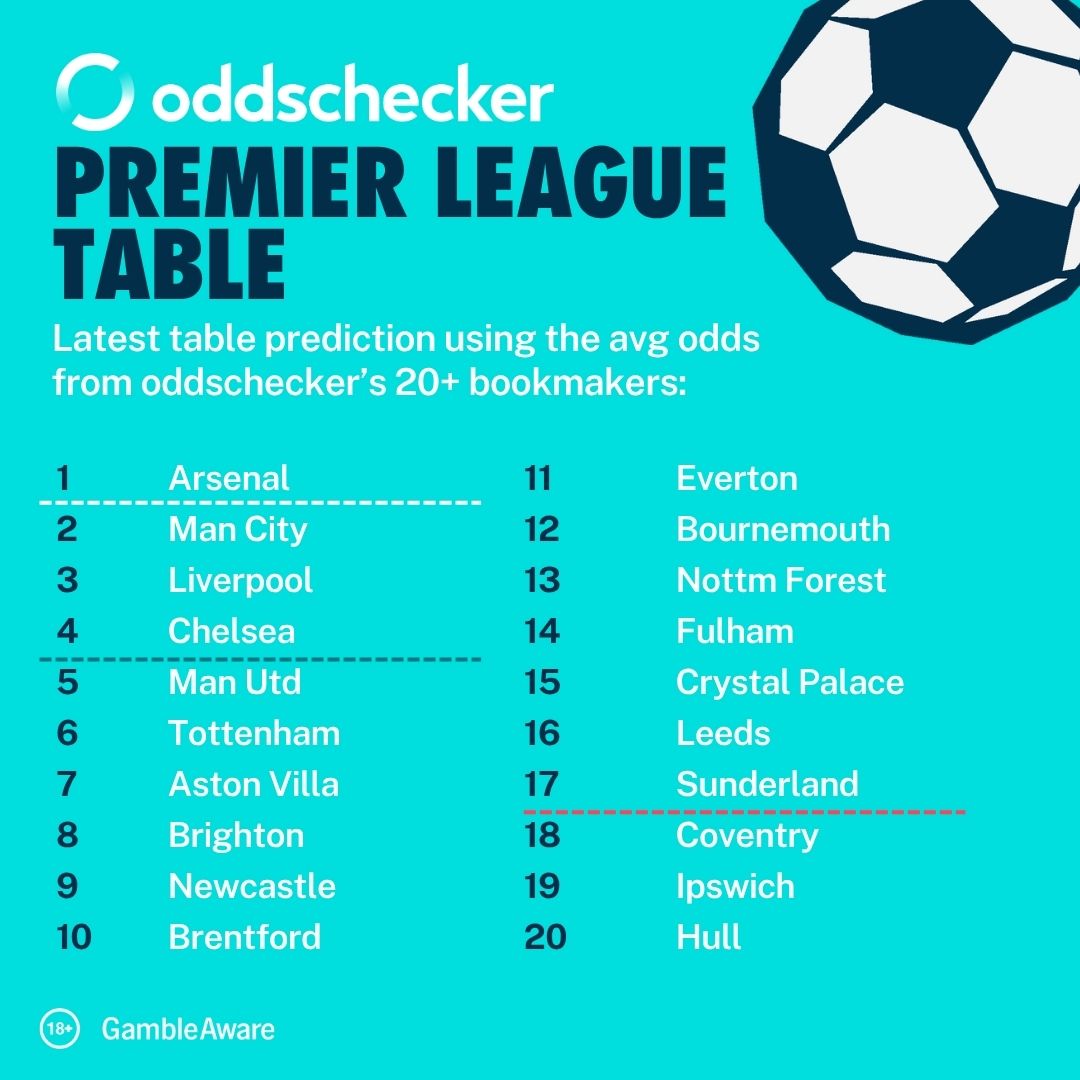
Here's the finishing order the odds currently point to, and the case for and against each club living up to it.
Premier League 2026/27 Winner Odds
Premier League 2026/27 Predicted Table
Premier League 2026/27 Team-by-Team Preview
1) Arsenal
The champions return with the deepest, most settled squad in the league and a defensive record that isn't just the best in the Premier League, it's not particularly close. Over the last three seasons Arsenal's xGA numbers have sat roughly 37 expected goals clear of second-placed Manchester City, and City's own advantage over 12th-placed Fulham is about the same margin. Bruno Guimarães arrives from Newcastle to add ball-progression in front of that defence, alongside Piero Hincapié and Christos Tzolis with Ezri Konsa adding more depth at the back. The one real threat to a repeat title isn't personnel, it's fitness. Bukayo Saka carried an Achilles issue through the World Cup, Declan Rice has had back and hamstring trouble, and William Saliba aggravated a back injury that's expected to keep him out for the opening months. If Arsenal's front-line stays fit, there's no obvious challenger.
2) Manchester City
Life after Pep Guardiola begins under Enzo Maresca, and the numbers underline just how big a shift that is. City have won 38 major trophies in their history, and Guardiola was in the dugout for more than half of them. Rodri, Bernardo Silva, John Stones and James Trafford have all left, and a chastening Community Shield defeat to Arsenal did little to settle nerves early. But this is still a roster stacked with players 27 or under in their prime: Erling Haaland remains one of the most ruthless finishers in the world, Rayan Cherki and Jérémy Doku offer chance creation and creativty, and club-record signing Elliot Anderson (in from Nottingham Forest) is viewed as an immediate upgrade in central midfield. Expect an awkward opening stretch before City settle into being Arsenal's closest challenger.
3) Liverpool
Arne Slot didn't survive a title defence that fell apart, and Andoni Iraola arrives from Bournemouth to try to reignite an attack that lost its intensity last season. Liverpool's passes-allowed-per-defensive-action figure, a standard measure of pressing intensity, was at its highest (i.e. least aggressive) mark in eight years. Mohamed Salah and Andrew Robertson have departed, while Ronald Araújo arrives on loan and Jérémy Jacquet and Victor Muñoz add fresh legs. Iraola has a track record of getting more out of attacking players than anyone previously managed - Alex Scott, Antoine Semenyo and others all improved markedly under him at Bournemouth - so the obvious subplot is whether he can finally unlock a full season of Florian Wirtz, who struggled to find his level under Slot. A top-four finish looks the realistic range, with title outsider status if the pressing snaps back into shape early.
4) Chelsea
No club spent more freely this summer, and, crucially, no top-half club is free of European football to help absorb it. Morgan Rogers (£117m from Villa) headlines a rebuild under Xabi Alonso that also brought in Maxence Lacroix, Geovany Quenda, Danny Welbeck and Jordan Henderson, the latter two specifically to add senior dressing-room presence after several seasons of being visibly too young. The underlying numbers back a bounce-back: Chelsea actually ranked fourth in expected-goal difference last season despite finishing 10th, arguably the unluckiest points return in the league. With Cole Palmer, Joao Pedro and Rogers all sharing the final third and no Thursday-night distractions, top four is squarely in play.
5) Manchester United
A first full season under Michael Carrick, and the data is a mixed bag: since he took over, United have ranked first in the league for points per game but fallen to fifth in expected-goal difference, having significantly outscored their chances created (33 goals from shots worth 26.9 expected). Youri Tielemans arrives from Villa to ease the creative burden on Bruno Fernandes, who set a Premier League assist record last season, but this remains a squad leaning heavily on the likes of Luke Shaw, Harry Maguire and a 31-year-old Fernandes for regular minutes, now with a Champions League campaign added to the fixture list. A leap into the true title picture feels premature, but a top-six finish with a trophy push looks realistic.
6) Tottenham
Spurs spent more this summer than Real Madrid, headlined by British-record-breaking outlay on Sandro Tonali (£100m) and Mateus Fernandes (£85m), plus Jan Paul van Hecke, Marcos Senesi and Andrew Robertson arriving to overhaul a defence that shipped a league-worst return last term. The most compelling stat in Spurs' favour: under De Zerbi for his seven games in interim charge last season, their adjusted goal difference was actually the best of any Tottenham manager, a level that projects to a top-six finish across a full campaign. The counter-argument is De Zerbi's own history - his Brighton exit turned sour over recruitment disagreements and his time at Marseille ended amid a breakdown in relations with the squad. If it holds together, this looks like a return to the top half after back-to-back 17th-place finishes.
7) Aston Villa
Emery has finished no lower than seventh across four Premier League seasons and reached the top four twice, but this summer he has lost some of his best players: Youri Tielemans, Lucas Digne and Morgan Rogers have all left, while Amadou Onana's World Cup ACL injury removes a key midfield body. Johan Manzambi and João Gomes look shrewd, high-upside replacements, but the wider concern is regression. Over the last three seasons only Arsenal and Manchester City have outperformed their underlying numbers by a bigger margin than Villa, whose expected-goal difference (based on xG) of plus-4.4 compares to an actual goal difference of plus-29. Add Champions League football into the mix and a step back towards mid-table feels the more likely outcome than another top-four charge.
8) Brighton
Back in Europe again, this time in the Conference League, and losing the two biggest drivers of last season's return: no side forced more high turnovers (12.4 per game) or scored more goals from them (23) than Brighton, and Danny Welbeck, their most productive attacking outlet after the press itself, has joined Chelsea. Luka Vuskovic arrives from Spurs as a long-term defensive rebuild piece, and Fabian Hürzeler's side finished the season strongly, averaging 1.83 points per game across their final 12 matches to climb into the top half. Balancing Conference League nights with sustaining that form is the challenge; a repeat top-half finish is possible but far from guaranteed.
9) Newcastle
A genuinely startling summer of upheaval: Eddie Howe is gone, and so are Bruno Guimarães, Sandro Tonali and Anthony Gordon - between them the club's leading names for goals, assists, dribbles and expected goals over the past four seasons. Matthias Jaissle, a serial title-winner in Austria with Red Bull Salzburg, has been backed with five signings averaging just 20 years old, headlined by Bazoumana Touré from Hoffenheim. It's a deliberate rebuild rather than a like-for-like refresh, and there's real risk in leaning so heavily on unproven talent all at once. Mid-table feels the sensible starting point while Jaissle finds his feet.
10) Brentford
No side in the league generated higher-quality shots last season than Brentford, who led the division in expected goals per shot (0.20 against a league average of 0.16) and shots on target percentage - the trademark of Keith Andrews' directness-and-set-pieces approach. They missed out on Europe by the smallest of margins (a single point, and goal difference, behind Brighton's Conference League spot) and have strengthened rather than sold this summer, headlined by club-record signing Mamadou Sangare from Lens. On Transfermarkt's squad-value rankings Brentford have steadily climbed from 16th to 10th in the league over recent seasons, this now looks like their most talented squad yet, with another push for Europe well within reach.
11) Everton
David Moyes brings continuity and, for once, no European commitments to juggle, but this remains one of the league's older squads - third-oldest by minutes played last season. Everton's defensive solidity is well documented but getting the ball up to the other side of the pitch has proven a problem. Last year only goalkeeper Jordan Pickford ranked inside the top 15 in the division for line-breaking passes through midfield. New arrival Hayden Hackney led the Championship in exactly that metric across the last two seasons, which hints at where improvement could come from. Iliman Ndiaye remains the standout individual talent, and Everton's floor under Moyes looks solid even if the ceiling is a mid-table finish at best.
12) Bournemouth
Replacing Andoni Iraola was always going to be the story of Bournemouth's season, and Marco Rose inherits a side that came within four points of the Champions League last term playing the fastest, most direct football in the league. They had the highest possession count, most ball recoveries, and the quickest average ball-progression speed of any Premier League team. History isn't kind to sides adding continental football for the first time: non-big-six clubs playing in Europe for the first time in recent seasons have dropped an average of roughly four to six places the following campaign. Rose's methods are stylistically similar to Iraola's, which should smooth the transition, but some regression from sixth looks the base case.
13) Nottingham Forest
Oliver Glasner walks into a club that used four different managers last season and still somehow finished with a squad capable of an entertaining campaign. Losing Elliot Anderson for a club-record fee stings statistically more than it might look on paper - he led Forest last season in chances created, progressive passes and carries, tackles and ball recoveries, essentially doing three players' jobs at once. Ousmane Diomande and free-transfer arrival Xaver Schlager add quality, and with no European football to juggle this time, a calmer mid-table finish under a genuinely well-regarded coach looks achievable, injecting stability after a genuinely chaotic 2025/26.
14) Fulham
Marco Silva's departure for Benfica ends a run of quietly effective work that kept an ageing Fulham squad competitive (they were the oldest team in the league last season by average minutes-weighted age). His replacement, Alvaro Arbeloa, arrives with the last item on his CV being a difficult caretaker spell at Real Madrid that ended with the team getting worse across almost every underlying metric, plus a reported training-ground bust-up between two of his own players. New signings Gonzalo García and César Palacios both worked under Arbeloa previously at Madrid's B team, so there's clearly a project in mind. Whether it translates to senior Premier League results is the biggest unknown of any mid-table side this season.
15) Crystal Palace
Pierre Sage replaces the outgoing Oliver Glasner having led Lens to a superb second-place finish in Ligue 1, but he inherits a squad stripped of its recent stars yet again. Michael Olise, Eberechi Eze, Marc Guéhi and now Maxence Lacroix have all left the club within the last two windows. Adam Wharton is the one remaining stars, and remarkably was one of only three Premier League players last season to add at least 10 goals' worth of value purely through non-shooting actions (alongside Jeremy Doku and Bruno Fernandes), despite missing out on his country's World Cup squad entirely. A cup run feels more likely than a league push this time.
16) Leeds United
Daniel Farke's promoted side were arguably the form team of the second half of last season. From December 1 onward, Leeds ranked seventh in the league for points per game, goal difference and expected-goal difference, built on forcing high turnovers and converting them (17 goals from turnovers in that spell, more than any other side). James Trafford arrives in goal off the back of a standout loan spell, having conceded over 22 fewer goals than expected across his last two full seasons of shot-stopping data, while Harry Wilson and Tarik Muharemovic add further quality. The obvious question is whether direct, selective-pressure football works a second time now teams know what's coming, but the platform here looks stronger than a typical newly promoted side heading into year two.
17) Sunderland
Seventh place last season was one of the most statistically fortunate finishes in the league. Sunderland ranked 18th in expected-goal difference and 19th in expected-goal difference specifically in matches they lost, despite winning enough of those games to bank a Europa League spot. Regis Le Bris has done almost no incoming business beyond free-transfer Thomas Meunier, keeping essentially the same group that shipped three-plus goal losses to Arsenal, Manchester City and Brentford last season, now with Thursday-night football added to the calendar. It all points to a significant fall from seventh, even accounting for how well the Stadium of Light crowd carried them through tight matches last term.
18) Coventry City
Frank Lampard's side were unquestionably the best team in the Championship last season. First for goals scored, goals conceded and expected-goal difference, and are the only promoted club yet to sell a single player this summer, backed instead by a wave of athletic, age-appropriate signings including Taiwo Awoniyi, Caleb Yirenkyi, Sidiki Chérif, Gustavo Hamer and Carl Rushworth. The concern is style: Coventry's approach was built on a hybrid approach that mixes direct progression with more patient patient possession. They dominated possession, played a high line, and advanced the ball quickly when opportunity arose. In the Premier League they won't be able to dominate play and they won't be able to be as aggressive in transition. Lampard needs to adapt from a side that dominated teams in the Championship and could afford to take risk into a side that is more pragmatic and efficient in what they do against superior opposition.
19) Ipswich Town
Kieran McKenna's exit was the shock of the promoted sides' summer. He has been replaced by Gary O'Neil who brings a track record of survival in the Premier League - 15th-place finishes at both Bournemouth and Wolves. Ipswich have backed him in the market, running one of the biggest negative net spends in world football this summer (over €115m and rising) to bring in Emersonn, Abdul Fatawu, Florentino and Daizen Maeda among 12 major additions. It's an ambitious rebuild without the manager who engineered back-to-back promotions, which makes a repeat of their previous immediate relegation a real danger. The loss of McKenna and the need to integrate so many new faces and create a new culture at the club might prove to be the biggest challenge of their season.
20) Hull City
The fact that Hull are even in the Premier League this season is quite shocking. If the league table was done by expected goals, they would have been relegated from the Championship last season. They finished the season before last outside of the relegation places solely on goal difference, they scraped into the play offs last season on the final day, and they won it with a last-minute winner. Historically, though, Championship form is a poor predictor of Premier League survival; Sean Dyche's Burnley and Sunderland both proved that recent Championship underperformers can avoid the drop. Hull's business reflects awareness of their own limitations: 11 signings, almost entirely aged 24 or under, including club-record fees for goalkeeper Konstantinos Tzolakis and defender Nobel Mendy, with senior experience added cheaply through Jack Butland, Hidemasa Morita and Matt Targett. Bottom of the table is the market's call, and the numbers back it up, but this is a club that has already defied expectation just by getting here.