







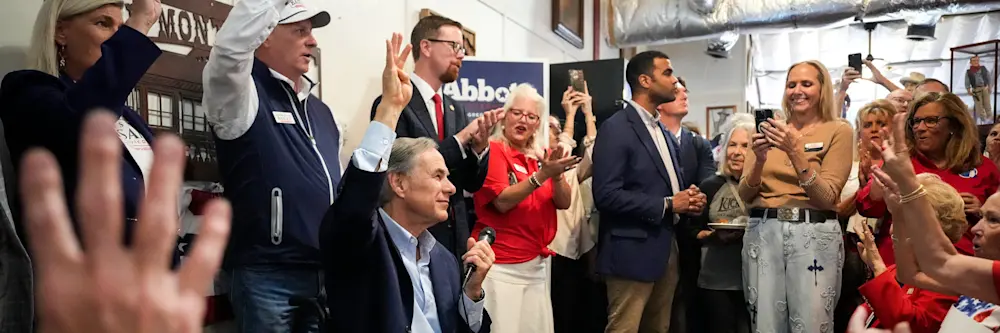
Texas Governor Odds: Is Greg Abbott on Upset Watch in Texas Gov Race?
Texas Gov. Greg Abbott enters Election Day with a shrinking prediction-market advantage over Democratic challenger Gina Hinojosa, as one of the nation's most reliably Republican states faces an unexpectedly competitive governor's race. Can Abbott secure a fourth consecutive term, or will Hinojosa capitalize on tightening polls and changing voter sentiment to deliver Texas its first Democratic governor since 1990? Check out the latest Texas governor election odds, polling, and prediction-market outlook for Tuesday, November 3.
Peter Alexis - November 3, 2026, 9:45 AM EST
4 Minute ReadTexas Governor Election Odds: Is Greg Abbott on Upset Alert Against Gina Hinojosa?
Texas's 2026 gubernatorial election has become increasingly competitive in its final weeks, with Republican incumbent Greg Abbott seeing his once-commanding prediction-market advantage narrow substantially. Abbott is now priced at 62.9% on Polymarket, compared with 38% for Democratic challenger Gina Hinojosa, following a prolonged shift in market sentiment that has accelerated throughout October.
The tightening contest represents a significant departure from Abbott's previous gubernatorial campaigns, which produced comfortable Republican victories in 2014, 2018 and 2022. With recent polling showing the candidates separated by only a few percentage points, attention has shifted toward whether the state's changing political dynamics and elevated midterm turnout will produce a different result in 2026.
Bet on the Texas Governor Race and more politics props with Kalshi Here
Latest Texas Governor Odds from Kalshi
Candidate | Implied Probability |
|---|---|
Greg Abbott (R) | 62% |
Gina Hinojosa (D) | 38% |
Texas Governor Prediction Market
Greg Abbott: 62.9% Chance
Abbott enters Election Day with a 62.9% market-implied chance of winning a fourth term, down substantially from the approximately 90% pricing he maintained during the early stages of the election cycle. His market position fluctuated primarily between 75% and 90% from March through August before weakening more consistently in September and October.
The three-term governor has served since January 2015 and remains one of the most prominent Republican executives in the country. Abbott has emphasized his administration's economic record, border security policies and proposals to reduce property taxes, while defending his conservative policy agenda against criticism from Hinojosa and other Democrats.
Gina Hinojosa: 38% Chance
Hinojosa has climbed to approximately 38% on Polymarket after spending much of the early election cycle below 10%. Her market-implied chance began rising during the spring, briefly surpassed 20% in March and has accelerated sharply since September, reaching its highest levels entering Election Day.
The Democratic state representative from Austin has centered her campaign on affordability, public education and criticism of Abbott's leadership. Hinojosa has also emphasized rising household expenses, electricity costs and opposition to the state's private-school voucher program, seeking to differentiate her platform from the governor's established Republican agenda.
Why Have Greg Abbott's Texas Governor Odds Fallen?
Abbott's prediction-market decline has developed over several months rather than through a single dramatic reversal. While the Republican governor maintained pricing near 90% during portions of the summer, his advantage began narrowing more consistently in August before accelerating downward during the final weeks of the campaign.
The most significant movement has occurred since early October, when Abbott still traded around 75% to 80%. His market-implied chance has subsequently dropped into the low 60s, while Hinojosa's price has approached 40%, reflecting a substantial change in how participants are pricing the election's possible outcomes.
That movement has coincided with tightening public polling, including several recent surveys placing the candidates within one or two percentage points. The growing competitiveness of those surveys offers context for the market's changing prices, although the exact influence of individual polling releases, campaign developments and trading activity cannot be isolated.
The contract has generated approximately $3.13 million in reported Polymarket trading volume, providing another measure of attention surrounding the race. However, the trading figures represent market activity rather than independent evidence about voter preferences or turnout.
Texas Governor Polling: Abbott and Hinojosa Separated by Just Two Points
The latest polling offers a considerably closer picture than Texas's previous gubernatorial elections. The RealClearPolling average covering October 15 through November 1 placed Abbott at 49.7% and Hinojosa at 47.4%, giving the Republican governor a narrow 2.3-point advantage.
Several of the final surveys have shown an even smaller margin. A New York Times/Siena poll conducted October 27 through November 1 measured Hinojosa ahead 48% to 47%, while an AtlasIntel survey showed the Democrat leading 50% to 49%. Other polls, including YouGov and Emerson, measured narrow Abbott advantages, illustrating the variation between likely-voter samples.
Earlier October polling had generally shown Abbott with a somewhat larger advantage. A Fox News survey conducted October 15–19 measured the governor ahead 52% to 47%, while an Emerson College poll from a similar period placed him four points ahead, highlighting the narrower margins recorded in several subsequent surveys.
The contrast between polling and prediction-market pricing remains important. Abbott's 62.9% Polymarket figure reflects a market-implied chance of winning, not a projection that he will receive 62.9% of the statewide vote. Current polling instead indicates a contest where relatively modest changes in voter participation or candidate support could have a meaningful effect on the final margin.
Could Gina Hinojosa End Texas's 36-Year Democratic Governor Drought?
Texas has not elected a Democratic governor since Ann Richards won the office in 1990. Richards subsequently lost her reelection campaign to George W. Bush in 1994, beginning an uninterrupted period of Republican control of the governor's office that has lasted more than three decades.
Abbott has continued that streak with three successful statewide campaigns, most recently defeating Democrat Beto O'Rourke in 2022. The governor received 54.8% of the vote against O'Rourke's 43.9%, producing a margin of approximately 11 percentage points and reinforcing the Republican Party's longstanding statewide advantage.
Republicans have also maintained a substantial edge in recent presidential elections. Donald Trump carried Texas in 2024 by approximately 14 points, demonstrating the scale of the Republican voting coalition that Democrats have struggled to overcome in statewide federal elections.
However, gubernatorial elections take place under different political conditions than presidential contests, particularly during midterm years. The 2026 race involves a long-serving incumbent, a national Republican administration and a Democratic challenger emphasizing state-level economic and education issues, creating a different electoral environment from the one in 2024.
Affordability and Education Dominate the Texas Governor Race
Economic concerns have become central to both campaigns, particularly as Texans confront rising property taxes, housing expenses and electricity costs. Abbott has proposed substantial property tax reductions, including a plan to eliminate school district property taxes on homesteads while replacing the lost revenue with state funding.
Hinojosa has offered a different set of economic proposals, including a one-time $1,500 payment to Texas households funded through the state's Rainy Day Fund. She has also advocated reducing electricity costs and revisiting corporate subsidies, although several of her proposals would require legislative approval rather than executive action alone.
Public education has become another major dividing line, with Hinojosa opposing Abbott's private-school voucher program and arguing that state resources should prioritize public schools. Abbott has defended the voucher initiative as an expansion of educational choice while continuing to promote his administration's broader education policies.
The development of large data centers has also emerged as a campaign issue, particularly amid concerns about electricity demand, water usage and infrastructure. Both candidates have addressed the industry's expansion, although their proposed approaches and broader economic priorities differ.
Record Early Voting Adds Another Variable to Texas Election
Texas recorded more than 7.4 million early votes during the 2026 midterm election, representing approximately 39% of registered voters. That participation rate nearly matched the state's modern midterm record from 2018, establishing an unusually active electorate before Election Day itself.
The elevated participation provides important context for the governor's race, although higher turnout does not inherently benefit either political party. The composition of those voters, particularly their geographic distribution and whether they participate consistently in midterm elections, will be more informative than the statewide total alone.
Harris County around Houston, Dallas County, Travis County around Austin and Bexar County around San Antonio represent major population centers whose vote margins will contribute significantly to the statewide result. Meanwhile, Republican performance in smaller metropolitan areas, exurban counties and rural Texas will remain equally important to understanding how the final vote compares with recent elections.
Suburban counties surrounding Dallas-Fort Worth, including Collin, Denton and Tarrant, will also warrant attention as votes are counted. Their population growth and changing voting patterns have made them increasingly important to statewide electoral analysis, particularly when polling indicates a smaller overall margin than in recent cycles.
What Would a Democratic Victory Mean for Texas?
A Hinojosa victory would mark the first Democratic gubernatorial election win in Texas since 1990 and end a Republican hold on the office that began when George W. Bush took office in January 1995. The result would represent a significant historical milestone in a state where Democrats have repeatedly fallen short in high-profile statewide contests.
It would also produce a divided state government, given the Republican Party's established strength in the Texas Legislature. That arrangement would create legislative challenges for major policy proposals, particularly those involving taxation, education funding and new state spending.
For Abbott, another victory would secure an unprecedented fourth consecutive gubernatorial term in Texas. It would extend a political tenure that has already encompassed major changes in the state's economy, population, public education system and relationship with the federal government.
The outcome also carries implications for how national political observers interpret Texas's shifting electorate. Regardless of the final result, the narrower late polling margins provide a different picture from the double-digit victory Abbott recorded four years earlier.
Texas Governor Election Outlook: What to Watch on Tuesday
Texas enters Election Day with a notable divergence between its recent Republican voting history and an increasingly competitive gubernatorial contest. Abbott's 62.9% prediction-market price remains higher than Hinojosa's 38%, but his advantage has narrowed substantially from the roughly 90% pricing recorded earlier in the election cycle.
Recent polling reinforces the importance of that movement, with the RealClearPolling average separating the candidates by just 2.3 points and several individual surveys measuring margins of one percentage point. Those measurements show a much closer contest than Abbott's previous campaigns, although differences in survey methodology and turnout assumptions remain important uncertainties.
Election Night results will help clarify whether voter preferences resemble the final polling averages, particularly as ballots from major metropolitan areas, suburban counties and rural regions are reported. The unusually high early-voting participation adds another factor to monitor, without establishing which candidate benefited from the increase.
For a governor who won reelection by approximately 11 points in 2022, the narrowing market and polling margins represent a considerable change in the competitive environment. Whether those developments translate into a change in Texas's governorship will depend on the actual statewide vote, with the final outcome determining if Republicans extend their three-decade hold on the office or Democrats achieve their first gubernatorial victory since 1990.
More of oddschecker
Affiliate Disclosure.
We are not a gambling or betting operator, but we receive a commission from these companies when we advertise their brands and refer customers to them (affiliate marketing). We provide information, odds information and links to websites of these companies. Some of the information made available on our site may be positioned as a result of a commission paid to us by a third party. We do not take or place bets/transactions and any information on Our Products is provided for entertainment purposes only.