






Kansas Senate Odds: Adam Hamilton Takes Lead in Stunning Reversal, Kansas Favored for First Democrat in 94 Years
Kansas's 2026 Senate race has undergone one of the most dramatic prediction-market reversals of the midterm elections, with Democrat Adam Hamilton surging past Republican incumbent Roger Marshall just days before voters head to the polls. Can Hamilton deliver Kansas its first Democratic Senate election victory since 1932, or will the state's longstanding Republican voting history produce another GOP victory? Check out the latest Kansas Senate election odds, polling, and prediction-market outlook for Tuesday, November 3.
Peter Alexis - November 3, 2026, 9:15 AM EST
4 Minute ReadKansas Senate Election Odds: Adam Hamilton Overtakes Roger Marshall in Stunning Late Flip
Kansas has emerged as one of the biggest late-breaking stories of the 2026 midterm elections, with Democrat Adam Hamilton overtaking Republican Senator Roger Marshall in prediction-market pricing just days before Election Day. Hamilton now holds a 63% market-implied chance of winning on Polymarket, compared with 37% for Marshall, marking a dramatic reversal in a state that has not elected a Democratic U.S. senator in more than 90 years.
The shift has been particularly striking because Kansas entered the election cycle with a substantial Republican advantage, supported by decades of GOP dominance and Donald Trump's 16-point statewide victory in 2024. However, tightening polling, changing voter sentiment and a series of late campaign developments have transformed the market's assessment of the contest, turning an initially overlooked Senate race into a closely watched national battleground.
Bet on the Kansas Senate Odds and more politics props with Polymarket Here
Kansas Senate Odds
Candidate | Implied Probability |
|---|---|
Adam Hamilton (D) | 63% |
Roger Marshall (R) | 37% |
Ohio Senate Odds Breakdown
Adam Hamilton: 63% Chance
Hamilton enters Election Day priced at 63% on Polymarket, completing a remarkable rise from approximately 17% in early September and around 35% at the beginning of October. His market-implied chance approached 40% in the final week of October before accelerating toward 50%, crossing that threshold over the weekend and climbing into the low 60s by November 2.
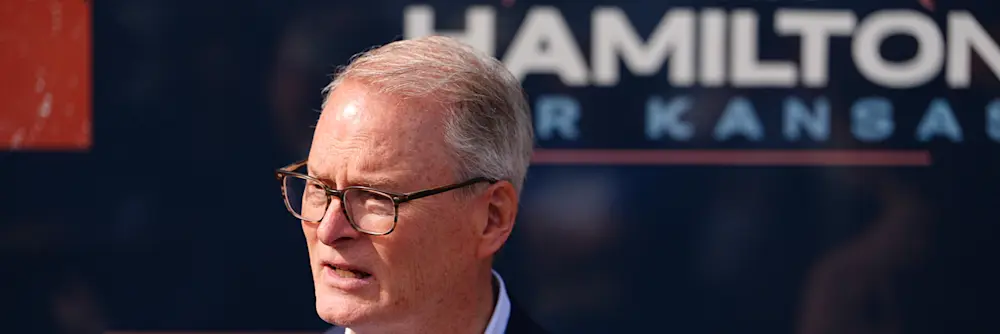
The Democratic challenger is a prominent United Methodist pastor from Leawood who has built his campaign around economic affordability, healthcare and appeals to independent and moderate Republican voters. His rapid improvement in market pricing has coincided with several late polls showing him ahead of Marshall, although those surveys generally indicate a significantly closer race than the current prediction-market percentages might suggest.
Roger Marshall: 37% Chance
Marshall has experienced an equally dramatic reversal, falling from approximately 83% in early September to just 37% entering Election Day. The Republican incumbent spent much of October trading around 60% before a sharp decline during the final days of the campaign eliminated his longstanding market advantage.
First elected to the Senate in 2020, Marshall is seeking a second term after previously representing Kansas's 1st Congressional District in the House. His campaign has emphasized conservative economic policies, border security and his alignment with the state's Republican electorate, while facing increased scrutiny over healthcare-related controversies and his record in Washington.
Why Did Kansas Senate Odds Flip So Dramatically?
The biggest movement in Kansas has occurred during the final week of the campaign, when Hamilton's market-implied chances climbed more than 20 percentage points. As recently as October 28, Marshall maintained a roughly 60%-40% advantage, but that gap narrowed rapidly before Hamilton moved ahead over the weekend.
The reversal has coincided with a series of polls showing Hamilton performing considerably better than Kansas's traditional Republican voting patterns would suggest. Voter dissatisfaction with economic conditions, concerns about healthcare costs and questions surrounding Marshall's record have all featured prominently in the closing stages of the campaign.
Marshall has faced scrutiny over reports that his former medical practice pursued hundreds of patients for unpaid medical debts, with some cases resulting in arrests after missed court appearances. His representatives have defended his medical career, emphasizing the number of patients he treated and his willingness to provide care regardless of their financial circumstances.
The late market movement also reflects increased uncertainty about how Kansas voters will respond to the national political environment. While polling and campaign developments offer context for the shift, no single issue can be definitively identified as the cause of the change in trading prices.
Kansas Senate Polling: Hamilton Builds Late Advantage
Recent polling has provided substantial evidence of a competitive election, with several surveys showing Hamilton ahead despite Kansas's Republican political history. The RealClearPolling average through November 1 placed Hamilton at approximately 50% and Marshall at 46%, while individual polls showed margins ranging from one percentage point to considerably larger Democratic advantages.
A New York Times/Siena survey conducted from October 27 through November 1 showed Hamilton leading 49% to 44% among 736 likely voters. A CNN/SSRS poll measured a 49%-45% contest, while a YouGov survey showed a much narrower 50%-49% difference.
Another late survey conducted by The Washington Post and George Mason University found Hamilton ahead 52% to 43%, although researchers highlighted significant concerns about partisan differences in survey participation. Democratic voters were substantially more willing to respond than Republicans, raising questions about whether the sample accurately reflected the statewide electorate.
These polling results help explain the uncertainty surrounding Kansas, but they are distinct from the prediction-market figures. Hamilton's 63% price represents a market-implied chance of winning the election rather than an expected 63% vote share, with the underlying surveys suggesting a much narrower division of voter support.
Kansas Has Not Elected a Democratic Senator Since 1932
The historical significance of the Kansas Senate election extends far beyond the current candidates. The state has not elected a Democrat to the U.S. Senate since 1932, when George McGill won reelection after initially entering the chamber through a special election in 1930.
McGill subsequently lost his 1938 reelection campaign to Republican Clyde Reed, beginning an uninterrupted period of Republican representation in both of Kansas's Senate seats. The particular seat Marshall currently occupies has remained in Republican hands since 1919, making it one of the longest continuous partisan holds on an individual Senate seat in American history.
Kansas's recent presidential results further illustrate the state's Republican political identity. Trump carried Kansas by approximately 16 percentage points in 2024 and nearly 15 points in 2020, while Republicans have maintained both U.S. Senate seats throughout the modern political era.
However, statewide elections have occasionally produced different outcomes. Democrat Laura Kelly won the Kansas governorship in 2018 and secured reelection in 2022, demonstrating that the state's voters have supported Democratic candidates in high-profile statewide contests despite consistently favoring Republicans in federal elections.
Could Roger Marshall Still Benefit From Republican Turnout?
One of the central uncertainties entering Election Day is whether the polling electorate accurately captures Kansas's Republican voting base. The state's substantial Republican registration advantage and recent presidential results provide important context, particularly given concerns that some surveys may have struggled to reach less politically engaged conservative voters.
Marshall's performance across western Kansas, rural agricultural communities and Republican-leaning areas surrounding Wichita will be important as results emerge. Those regions have historically delivered substantial GOP margins, meaning their turnout and vote shares will help determine how the statewide result compares with recent polling.
Hamilton's campaign has emphasized opportunities to attract independent voters and Republicans dissatisfied with the national political environment. His potential support in Johnson County, the Kansas City suburbs, Lawrence and the state's other population centers will be equally important to understanding whether the final electorate differs from Kansas's recent federal voting patterns.
A Libertarian candidate, David Graham, adds another element to the contest, with some surveys registering measurable third-party support. In a race where the major candidates are separated by only a few points in polling, the size and distribution of that vote could also influence the final margin.
What Would a Democratic Kansas Senate Victory Mean?
A Democratic victory in Kansas would represent a historic change in the state's congressional representation, ending a Senate election losing streak that stretches back to the Great Depression. It would also add an unexpected pickup to the Democratic Party's national Senate map, where control of the chamber depends on results across several closely contested states.
For Republicans, holding the seat would preserve a longstanding advantage in one of the party's traditionally reliable Senate states. The unexpectedly competitive campaign has nevertheless expanded the number of races receiving national attention during the final days of the 2026 midterms.
Kansas also illustrates the distinction between a state's long-term partisan alignment and the dynamics of an individual election. The historical Republican advantage remains substantial, but the recent polling and prediction-market movements demonstrate how the current contest has developed differently from earlier statewide federal races.
Kansas Senate Election Outlook: Will the Late Market Flip Hold?
Kansas enters Election Day with one of the sharpest contrasts between its historical voting record and its current prediction-market pricing. Hamilton has moved from a substantial market underdog earlier in the election cycle to 63% on Polymarket, while Marshall's corresponding price has fallen to 37%.
That reversal has occurred alongside polling showing Hamilton with a narrow lead, although survey response differences, Republican turnout and third-party voting introduce uncertainty into the final result. The market has already undergone a significant reassessment, but its current pricing does not establish how voters will ultimately cast their ballots.
The pace of the movement has made Kansas particularly notable among competitive Senate races. While some contests have experienced months of relatively stable pricing, Kansas shifted from a clear Republican market advantage to a Democratic one in a matter of days.
With more than $11.2 million in reported trading volume and the possibility of ending a Democratic Senate election drought dating to 1932, Kansas has become one of the most consequential races to monitor as votes are counted. The central question is whether the late change in market expectations will be reflected in the final statewide results or whether the election will instead demonstrate the continuing strength of Kansas's Republican electorate.
- Pick: Roger Marshall (37%) Bet on the Kansas Senate Odds with Polymarket Here
More of oddschecker
Affiliate Disclosure.
We are not a gambling or betting operator, but we receive a commission from these companies when we advertise their brands and refer customers to them (affiliate marketing). We provide information, odds information and links to websites of these companies. Some of the information made available on our site may be positioned as a result of a commission paid to us by a third party. We do not take or place bets/transactions and any information on Our Products is provided for entertainment purposes only.